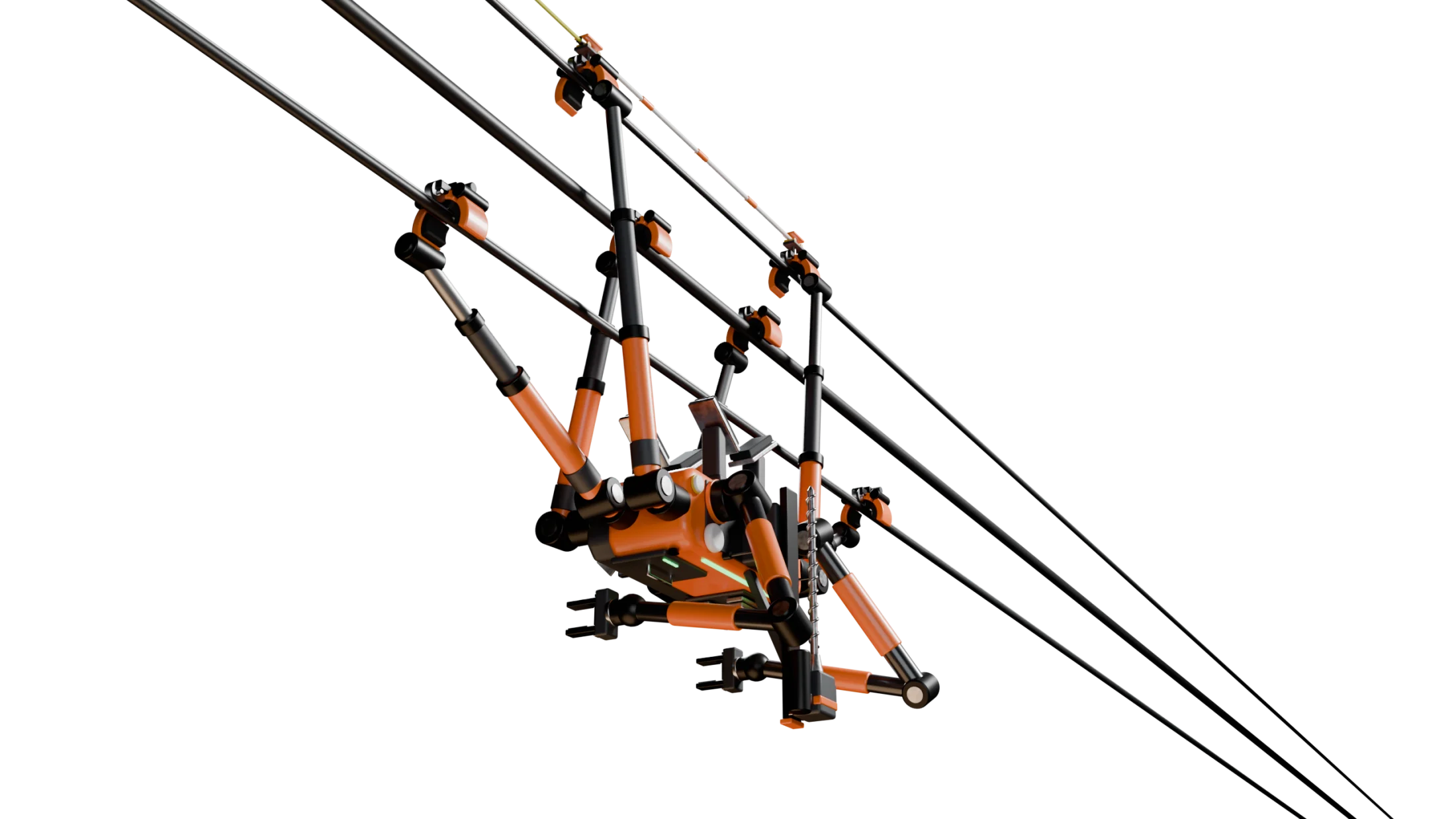
SpiderMonkey
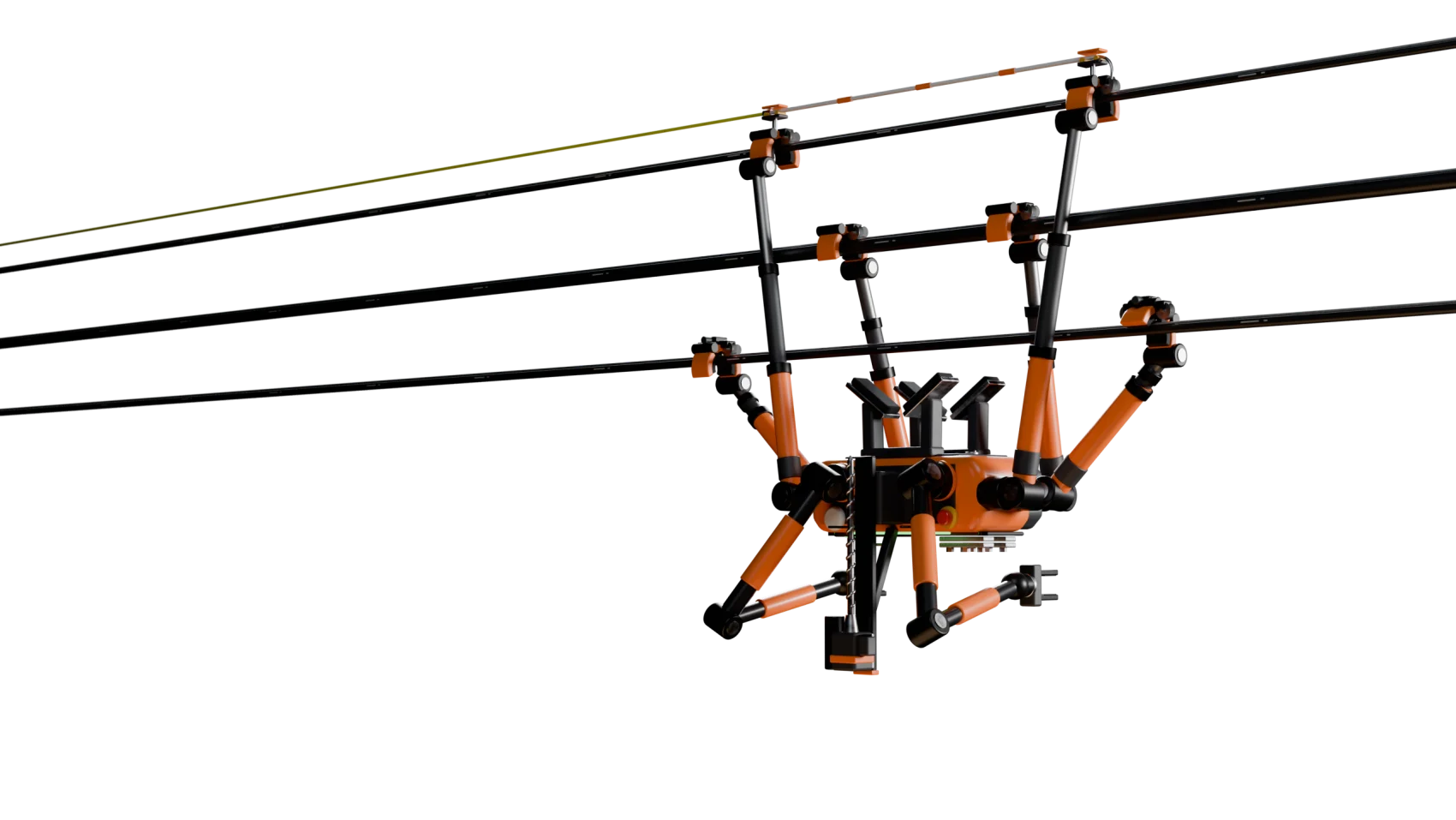
Rift's first machine. Six limbs, a drill and a pull line, working an aerial line build from the pole and the strand.
Everything it needshangs from the line.
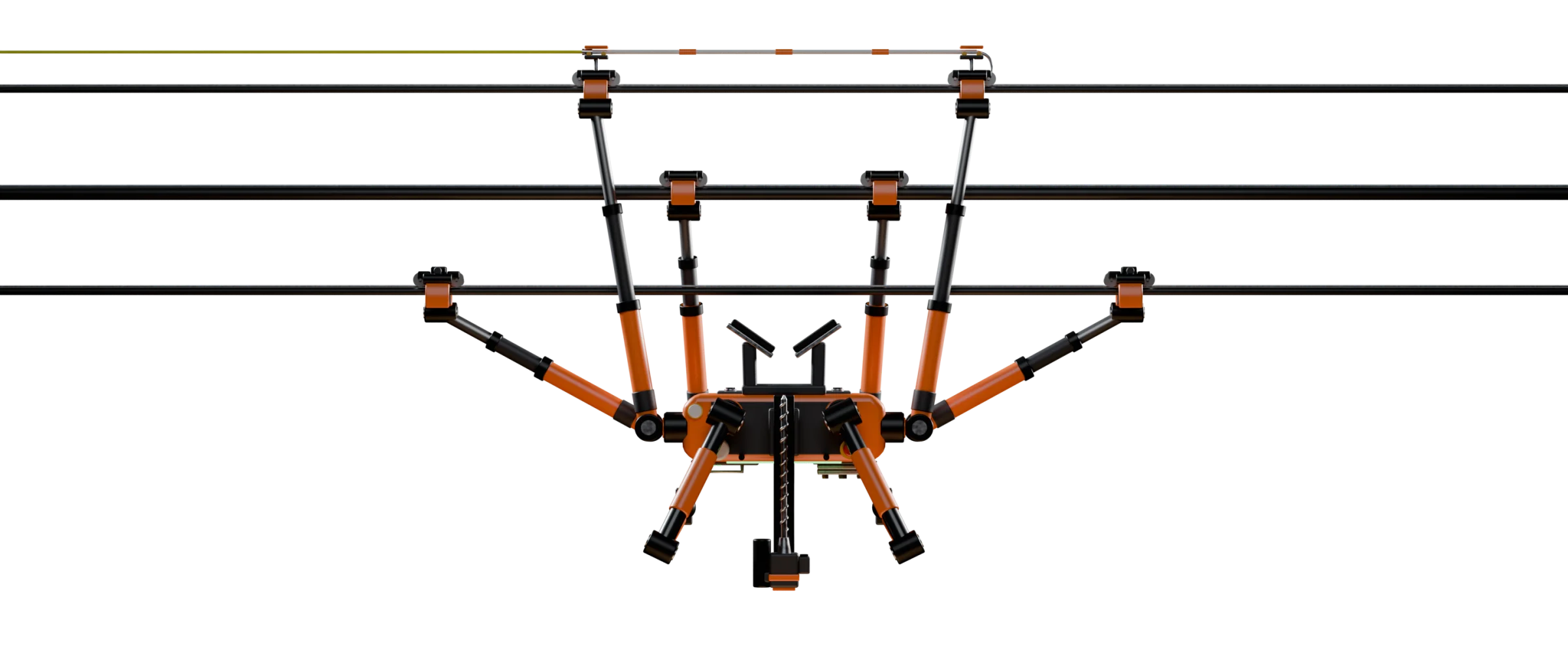
- 1
Pulling hands
Two hands carry jaws that close on bare steel strand. They do the pulling. The other four roll.
- 2
Six telescoping limbs
Each limb reaches, shortens and lifts on its own, so one can let go while the rest hold.
- 3
Pull line
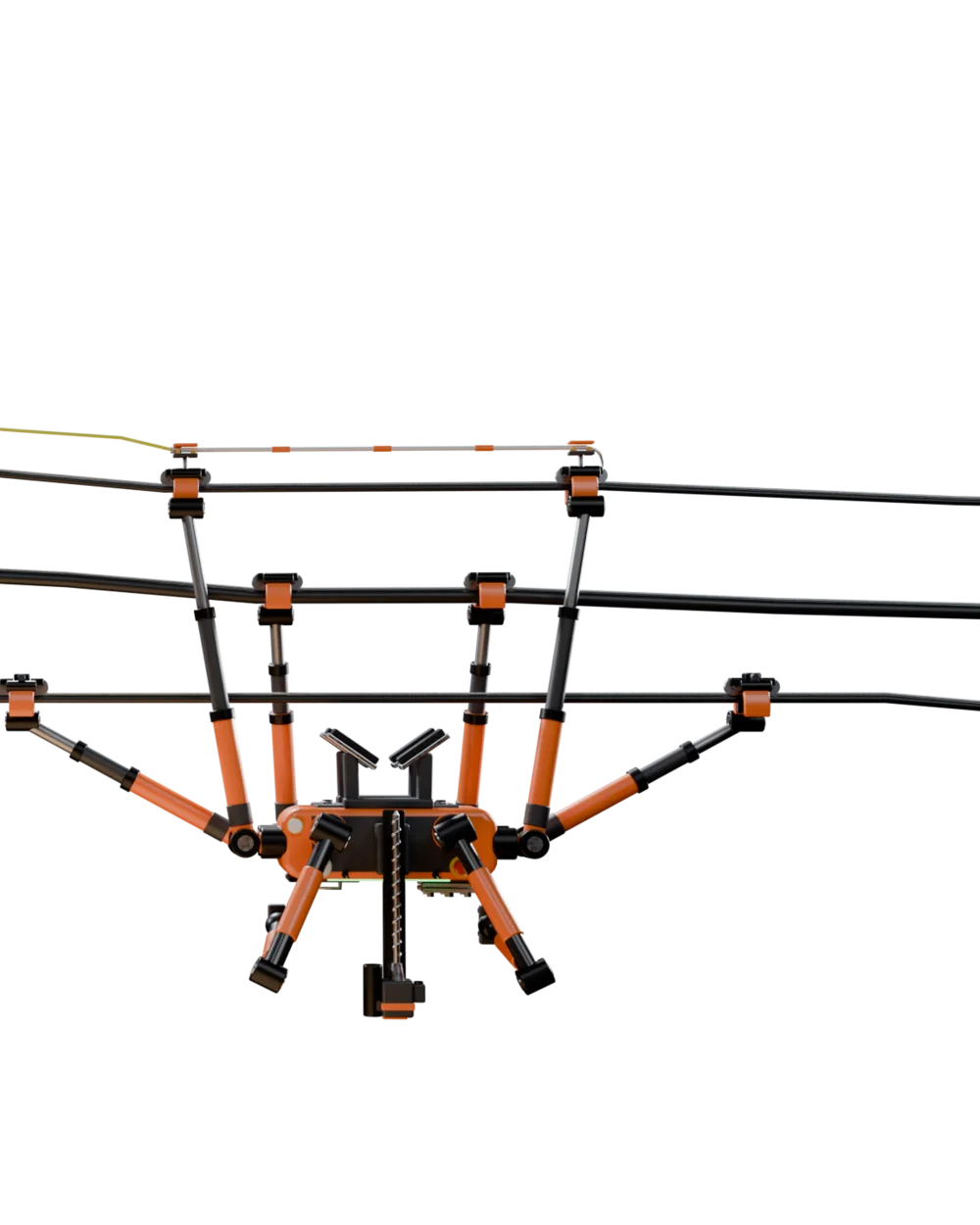
A wand holds the light pull line clear above the top strand while Spider Monkey crosses.
- 4
Drill
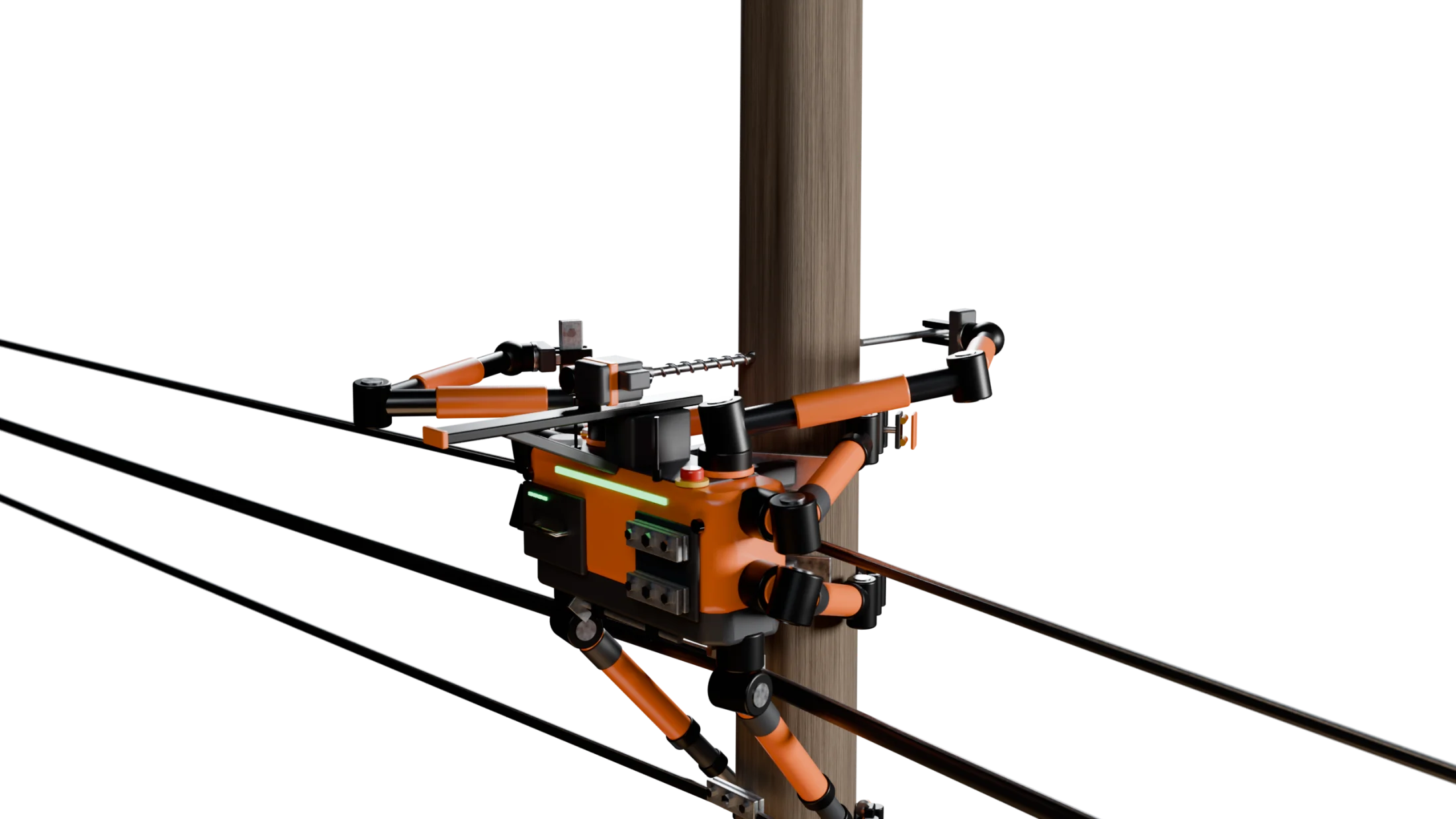
An auger on top of the body bores the pole for the new through-bolt.
- 5
Tool arms
Two arms with quick-change tooling place the clamp and run the nut at the pole.
Climb. Set. Cross. Pull.
One machine does every step of a span, from the base of one pole to the top of the next.
-
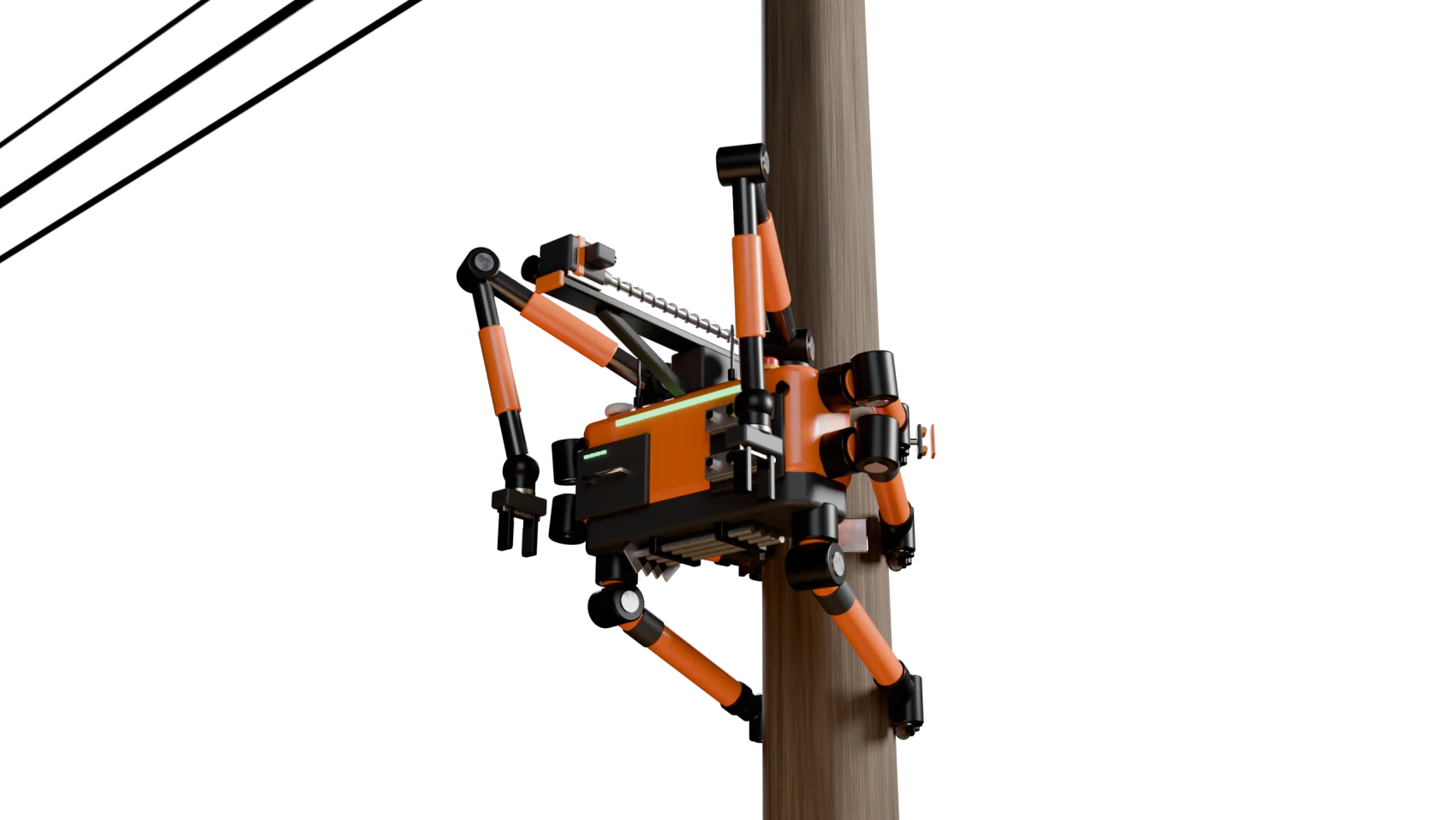
Climb
It walks up the pole on six padded limbs, two pairs holding while the third moves, and passes the existing attachments.
-
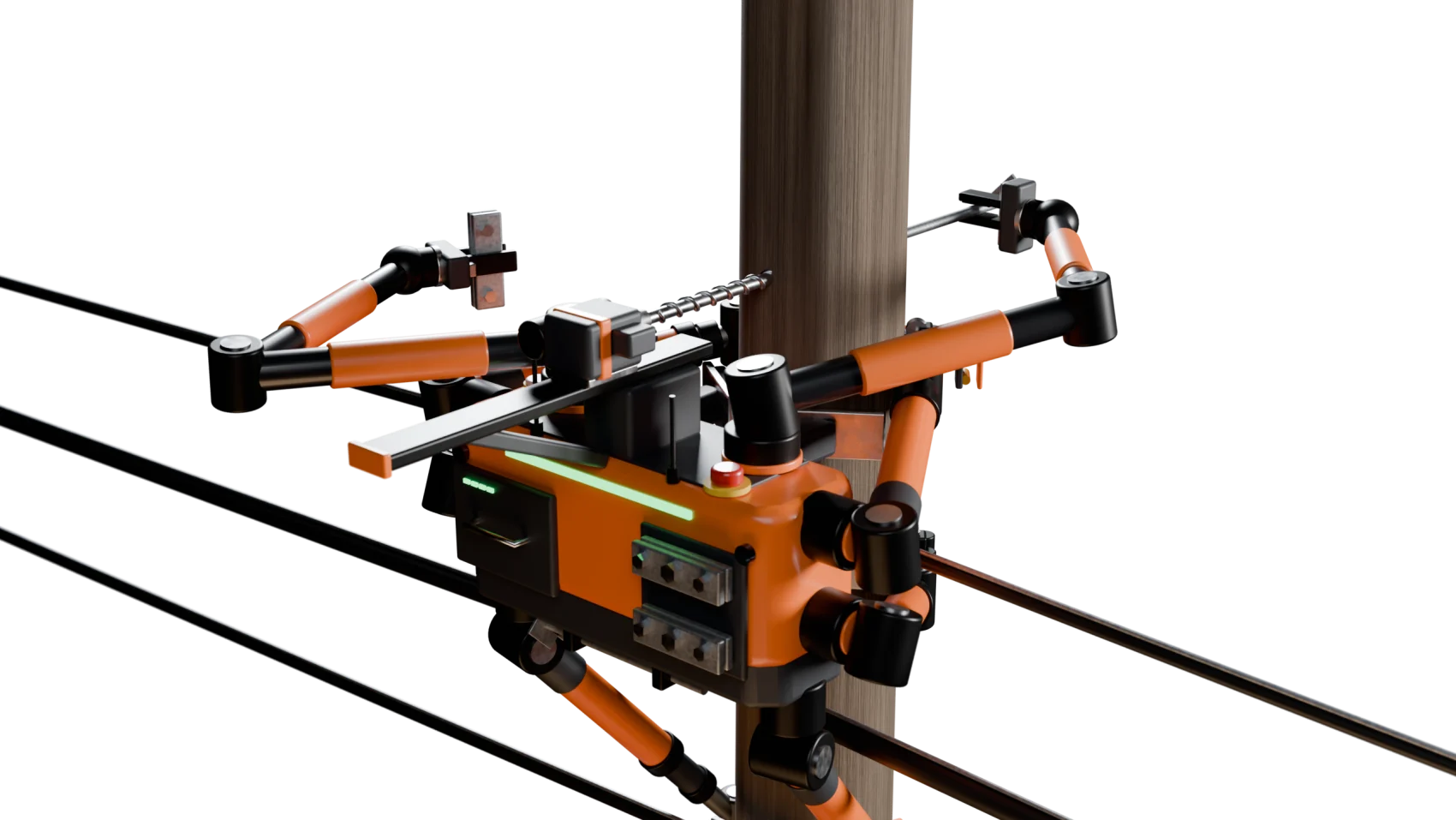
Set
It bores the through-hole and sets the hardware for the new strand in the top position, clear of every line already hanging.
-
Cross
It steps off the pole onto the existing strand and travels the span. Two hands grip the strand and pull. The other four roll.
-
Pull
It carries a light pull line across, so the new strand can follow. Two machines work as a pair and leapfrog down the route.
Still open in the design: the winch on the machine that draws the new strand over. In early versions the crew sets final tension.
Past a drop,hand over hand.
Where a service drop leaves the line, the hands let go in turn, reach past it and take hold again. At least three stay on the lines the whole time. Shown at three times real speed.
It holds the steel,not the cable.
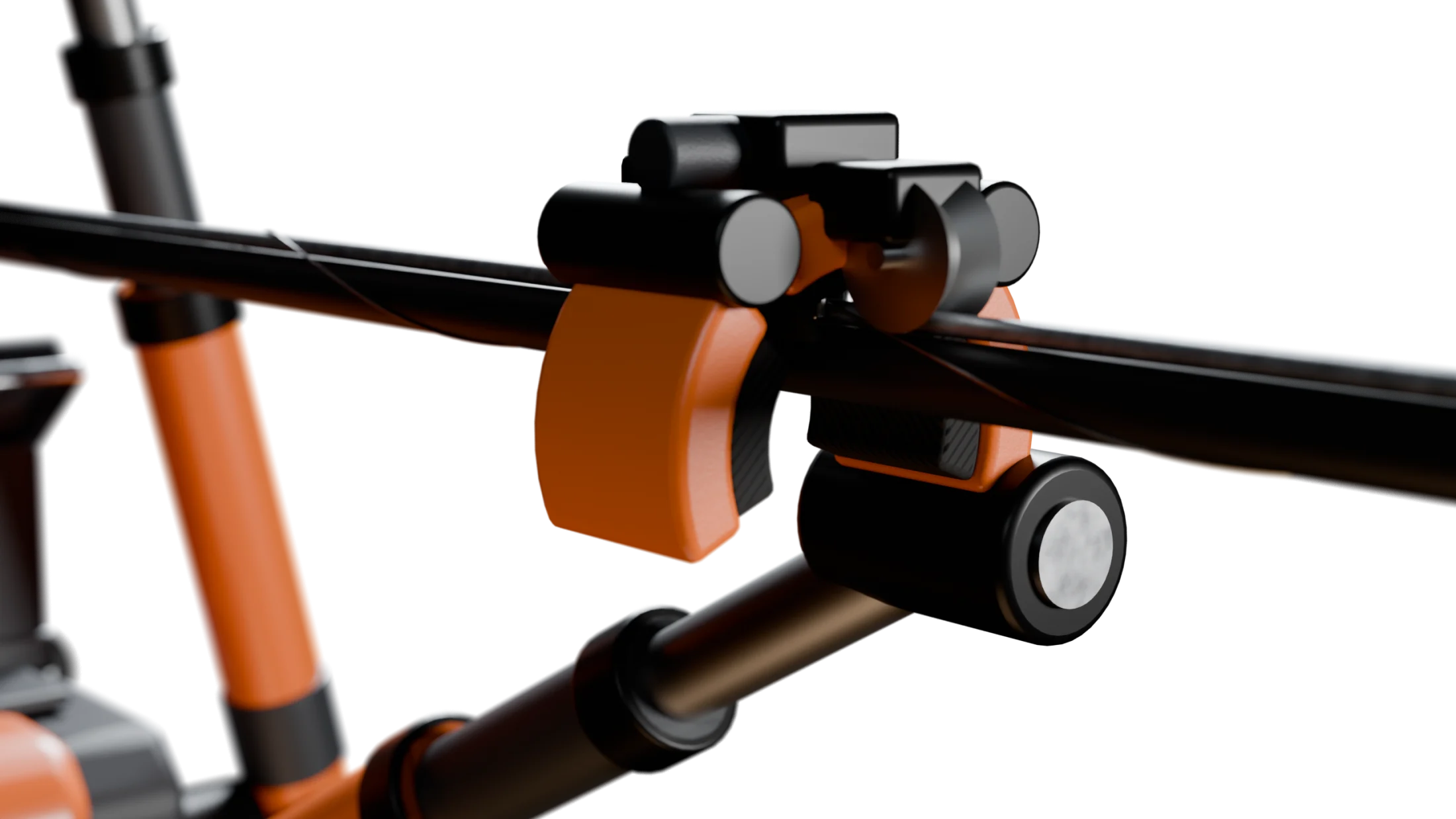
An existing line is a steel strand with a cable lashed underneath. The strand is built to carry load. The cable is not. Spider Monkey's jaws close on the strand in the gap above the cable, and its pads stay off the jacket.
- Strand gripped
- 1/4 in to 3/8 in steel
- Jaw squeeze
- About 93 lbf
- Jaw to cable jacket
- 1.2 to 2.8 mm clear
The drillrides on top.
New strand goes above what is already there. Spider Monkey climbs past the existing attachments, bores the through-hole and sets the hardware in the top position, holding the pole the whole time.
- Bore
- 11/16 in, through the pole
- New attachment
- Top position
- Tool arms
- Two, quick-change
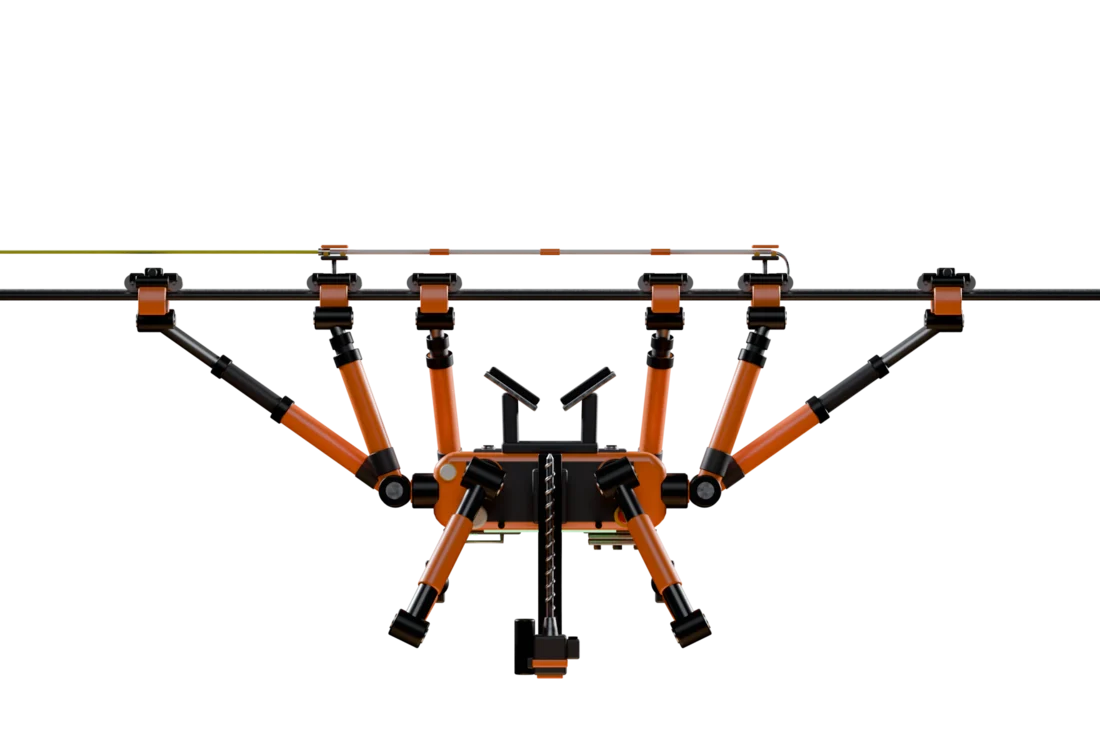
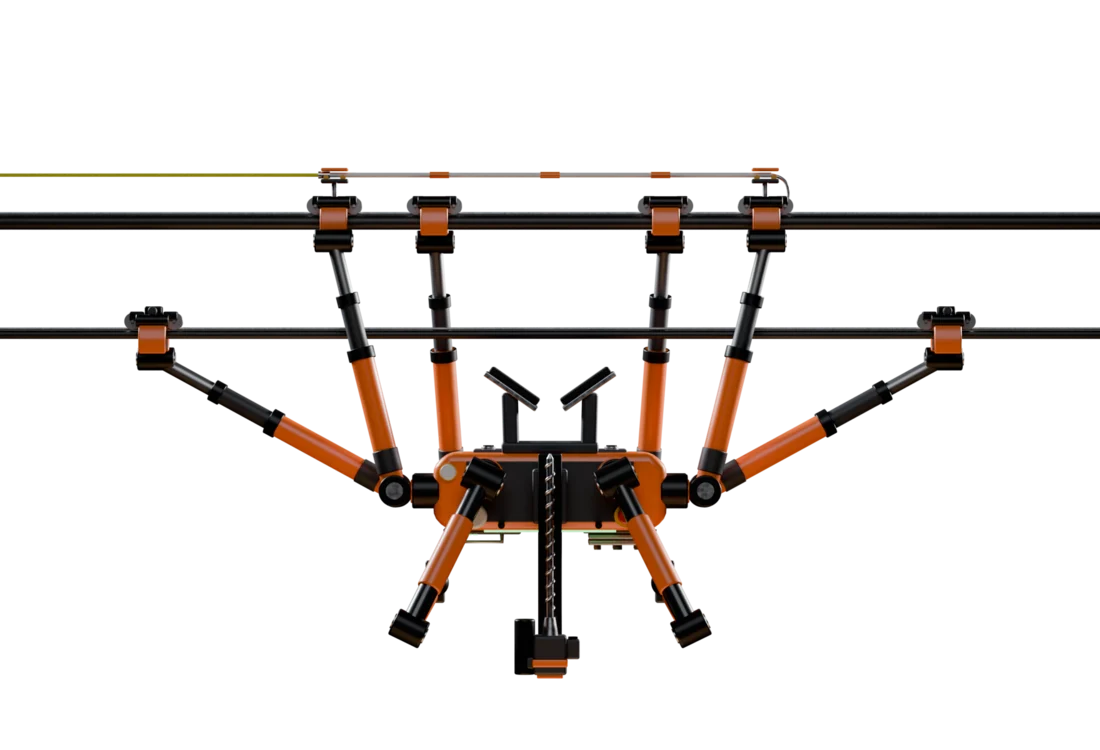
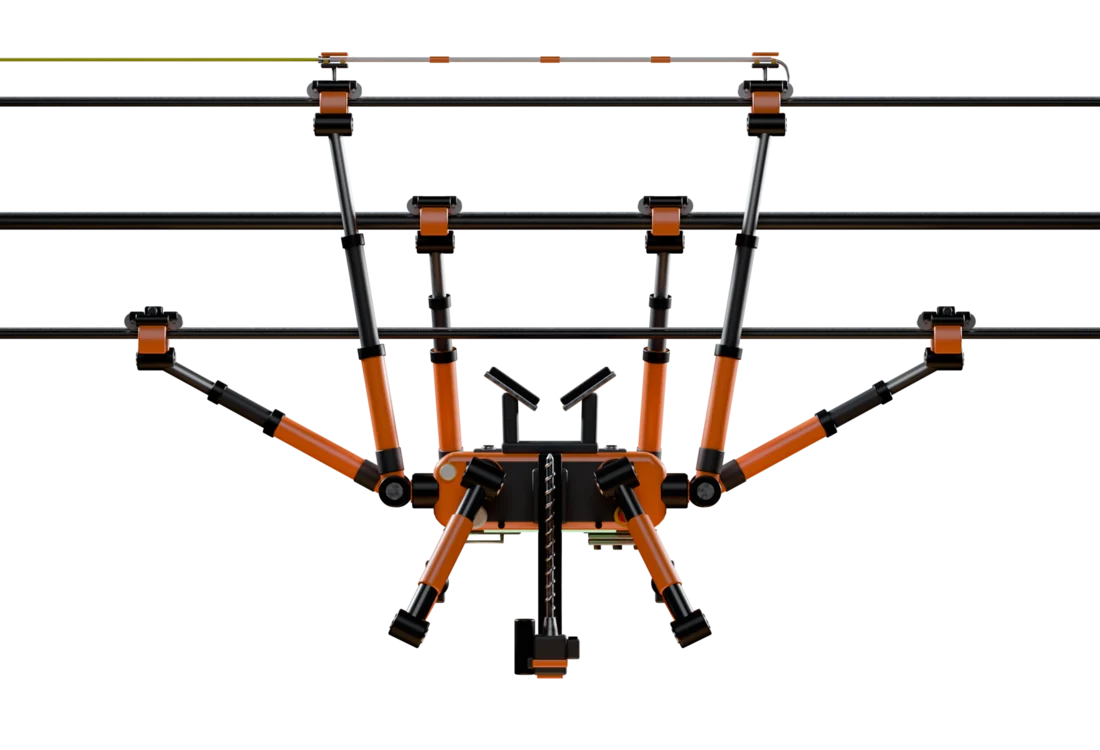
One line.Or two.Or three.
Routes are not uniform. One pole carries three lines, the next carries one. Spider Monkey rearranges its hands for what it finds.
Same machine, same hands, no change of hardware between spans.
By the numbers.
Spider Monkey is in development. These are the design targets for the engineering model, and they will move as hardware is built and tested.
Each one a leg on the pole and a hand on the line.
The same machine works under one, two or three existing lines.
About 12 to 20 spans on a charge, by first estimate.
On clear strand. A 45 m span with no drops in under four minutes.
- Configuration
- Six telescoping limbs, two tool arms
- Hands
- Padded hooks on every limbStrand-only jaws on the two pulling hands
- Works under
- One, two or three existing lines
- Strand gripped
- 1/4 in to 3/8 in steel strand
- Reference span
- 45 m (148 ft)
- Travel on strand
- 0.20 m/sSlower while the hands step past a drop
- Energy
- 2 kWh battery pack
- Range
- About 12 to 20 spans per chargeFirst estimate, with a fifth of the pack held in reserve
- Mass
- About 40 kg in the modelA first prototype built from catalogue parts is likely to be 45 to 55 kg
- Drill
- Top-mounted auger, 11/16 in through-bolt holes
- Strand pull
- Winch on the machineStill being designed
- Operating modes
- Teleoperation, step approval, supervised autonomy
- Stop
- Operator hold, obeyed by every machine on the job
- Status
- Engineering modelNot yet in service
Want Spider Monkeyon your route?
We would like to hear about the routes you are planning and what is already on the poles.